Physical Address
304 North Cardinal St.
Dorchester Center, MA 02124
Physical Address
304 North Cardinal St.
Dorchester Center, MA 02124
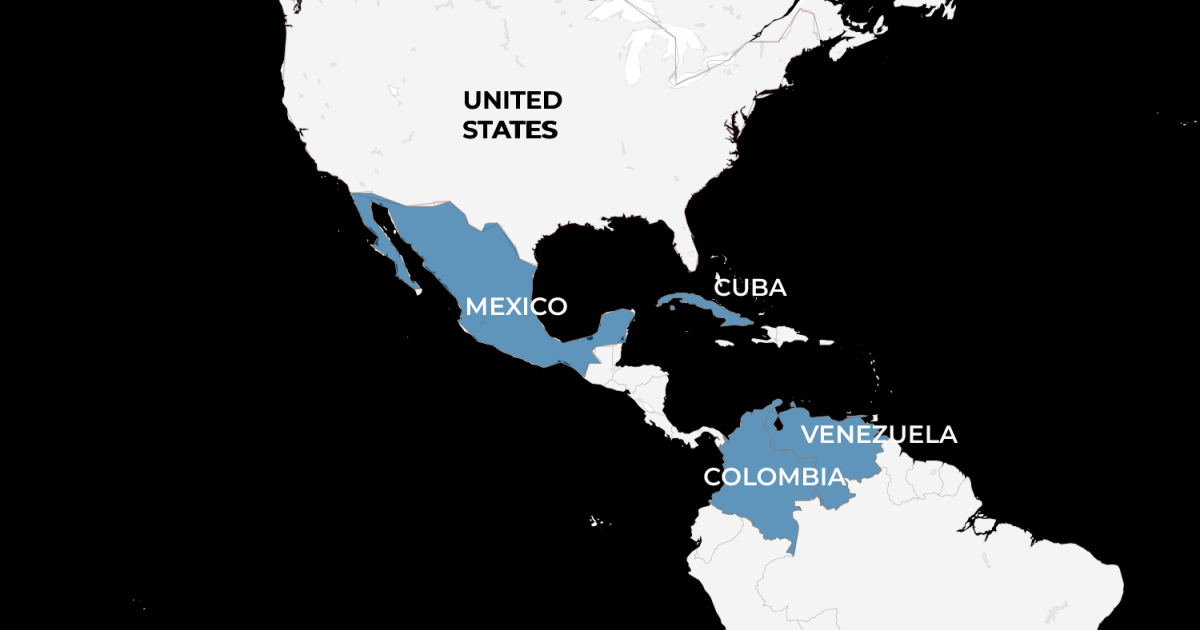
Over the weekend, the United States carried out a large-scale military strike against Venezuela And removed President Nicolas Maduro in a large escalation which caused shock waves throughout Latin America.
On Monday morning, US President Donald Trump redoubled his efforts: threatening action against the governments of Colombia, Cuba and Mexico unless they “get their act together,” claiming it is fighting drug trafficking and protecting U.S. interests in the Western Hemisphere.
These remarks reignite deep tensions linked to American interference in Latin America. Many of the governments targeted by Trump are reluctant for Washington’s involvement, but their militaries do not have the capacity to keep the United States at bay.

The United States has the most powerful military in the world and spends more on its military than the total budgets of the next 10 largest military spenders combined. In 2025, the United States’ defense budget was $895 billion, or about 3.1% of its gross domestic product.
According to the Global Firepower 2025 ranking, Brazil has the most powerful army in Latin America and ranks 11th in the world.
Mexico ranks 32nd in the world, Colombia 46th, Venezuela 50th and Cuba 67th. All of these countries are significantly inferior to the US military in all parameters, including the number of active personnel, military aircraft, battle tanks, naval assets and their military budgets.
In a standard war involving tanks, aircraft, and naval power, the United States maintains overwhelming superiority.
The only notable indicator these countries have in comparison to the United States is their paramilitary forces, which operate alongside regular armed forces, often using asymmetric warfare and unconventional tactics against conventional military strategies.

Several Latin American countries have a long history of paramilitary and irregular armed groups that have often played a role in the internal security of these countries. These groups are typically armed, organized, and politically influential, but operate outside the regular military chain of command.
Cuba has the third largest paramilitary force in the world, consisting of more than 1.14 million members, as reported by Global Firepower. These groups include state-controlled militias and neighborhood defense committees. The largest of them, the Militia of Territorial Troops, serves as a civilian reserve intended to assist the regular army against external threats or during internal crises.
In Venezuela, members of armed pro-government civilian groups known as “colectivos” have been accused of strengthening political control and intimidating opponents. Although not officially part of the armed forces, they are widely seen as operating with state tolerance or support, particularly during periods of unrest under Maduro.
In Colombia, right-wing paramilitary groups emerged in the 1980s to fight left-wing rebels. Although officially demobilized in the mid-2000s, many of them subsequently reappeared in the form of criminal or neo-paramilitary organizations, remaining active in rural areas. The first groups were organized with the participation of the Colombian army, following the advice of American counterinsurgency advisers during the Cold War.
In Mexico, heavily armed drug cartels operate as de facto paramilitary forces. Groups such as the Zetas, originally formed by former soldiers, possess military-grade weapons and exercise territorial control, often overrunning local police and challenging state authority. The Mexican military has been increasingly deployed in law enforcement roles in response.
Over the past two centuries, the United States has repeatedly interfered in Latin America.
In the late 19th and early 20th centuries, the so-called Banana Wars saw American forces deployed across Central America to protect corporate interests.
In 1934, President Franklin D. Roosevelt introduced the “Good Neighbor Policy,” promising nonintervention.
Yet during the Cold War, the United States financed operations to overthrow elected governments, often coordinated by the CIA, founded in 1947.
Panama is the only Latin American country that the United States has officially invaded, in 1989 under President George HW Bush. “Operation Just Cause” apparently aimed to remove President Manuel Noriega, who was later convicted of drug trafficking and other crimes.