Physical Address
304 North Cardinal St.
Dorchester Center, MA 02124
Physical Address
304 North Cardinal St.
Dorchester Center, MA 02124
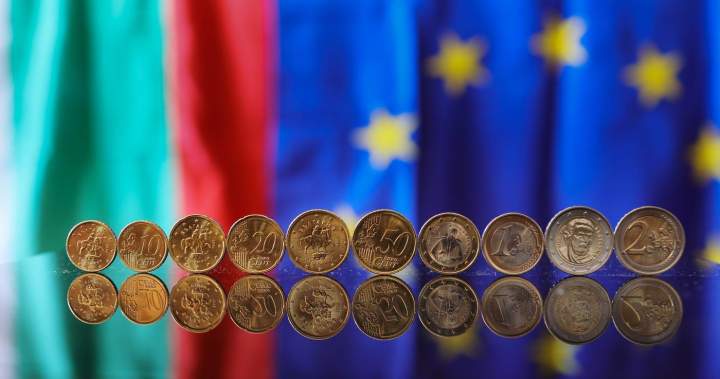
On New Year’s Day, Bulgaria becomes the 21st country to join the euro monetary union, thus strengthening its integration into the European Union. But the historic step comes amid political instability and skepticism among ordinary citizens, fueled by fears of rising prices.
Supporters of switching from the old currency, the lev, to the euro hail the move as one of the greatest achievements since the 1989 transition from a Soviet-style economy to democracy and a free market. They hope it will make the country more attractive to investors and strengthen its orientation towards a wealthier Western Europe.
But many people are worried, in a country where corruption is pervasive and trust in authorities is low. One fear is that traders will round up prices or use the change to make inflation worse, at a time when inflation has rebounded to 3.7%.
An EU Eurobarometer poll in March showed that 53% of 1,017 respondents were opposed to joining the eurozone, while 45% were in favor. Another Eurobarometer poll, carried out between October 9 and November 3 on a similar sample, showed that around half of Bulgarians were opposed to the single currency, while 42% were in favor. The margin of error was about plus or minus 3.1 percentage points for the March poll.
Some welcome the euro, others are wary
The government completed the process of adopting the euro by reducing inflation to 2.7% earlier this year in order to comply with EU rules and gain approval from European leaders. But clearing that hurdle was followed by a new chapter of political chaos. The government resigned after less than a year in power, amid nationwide anti-corruption protests. This has left the country without a regular budget for next year and is hampering plans for long-awaited structural reforms and decisions on the use of EU support funds.
New elections – the eighth in five years – are expected to take place next spring.
Nevelin Petrov, 64, declared himself in favor of the euro. “Bulgaria is a full member of the European Union and its rightful place is alongside other developed and democratic European nations,” he said. “I am convinced that the adoption of the euro will contribute to the long-term prosperity of our country,” he said.
Others, like Darina Vitova, who runs a pedicure salon in Sofia, said things were moving too fast, although she welcomed the change “in principle.”

Get the day’s top news, politics, business and current affairs headlines delivered to your inbox once a day.
“The standard of living and incomes in our country are far from those in the richest European countries, while prices here are rising and the life of the average person will become more difficult,” she said. She recognizes that when she travels to the beaches of neighboring Greece, it will be more convenient to pay with the same “pocket money” she uses at home.
Bulgaria, with its 6.4 million inhabitants, is one of the poorest members of the 27-country European Union. The average monthly salary is 1,300 euros ($1,530).
Countries joining the EU commit to the euro, but that can take years and some members are in no rush. Poland, in particular, has experienced strong economic growth since joining the EU in 2004, without adopting the euro.
Pro-Russian politicians fuel discontent
Opponents of membership have stoked fears that the changes could lead to more poverty and a loss of national identity. Social media has spread false information, including false claims that the euro could lead to the confiscation of bank accounts. Nationalist and pro-Russian groups are exploiting these fears.
European Central Bank President Christine Lagarde said countries experienced a small, transient price increase of 0.2 to 0.4 percent just after joining. Price increases may be more apparent than real, as cafes and hairdressers may delay printing new menus and price lists before the change, so that increases are only delayed and not caused by the euro.
Anti-euro rallies in May and September were organized by the pro-Russian Vazrazhdane party, but remained smaller than the mass demonstrations that toppled the government. While the anti-euro protests were supported by older people motivated by economic anxiety, the mass protests that toppled the government appeared to represent a younger electorate, fed up with corruption and eager to integrate into Europe.
An analyst believes that the adoption of the euro is a strategic plus
Anti-euro disinformation spread by pro-Russian politicians and social media aims “to reduce support for the European Union, NATO and Ukraine,” said Dimitar Keranov, program coordinator for Central European engagement at the German Marshall Fund in Berlin.
Bulgaria’s European integration “is not in Moscow’s interests at all, so if it can somehow polarize society and weaken support for the European Union, that’s what it is trying to achieve,” he said.
Adopting the euro is another way to combat Russian influence, he said: “The further Bulgaria advances in its European integration, the more difficult it becomes for Russia to influence the country. »
Petar Ganev, an analyst at the Sofia-based Institute of Market Economics, believes that the resignation of the outgoing government has sent a signal of uncertainty to foreign investors.
“Instead of capitalizing on the adoption of the euro as a strong and positive signal to the international community – to investors, debt holders and those who invest in Bulgarian assets and economic activity – we risk sending the opposite message,” Ganev said in an interview with the Associated Press.
Ganev believes that eurozone membership should be seen as an opportunity, an additional mechanism to fight corruption and the rule of law, even if it alone cannot resolve Bulgaria’s chronic cycle of elections, political fragmentation and instability.
Economic impact may be slight
Local economists believe that joining the euro will not bring radical changes to the Bulgarian economy. Indeed, the lev has been fixed by law since 1999 to the euro, at a fixed rate of 1 lev for 51 euro cents.
The lev and euro will be used for both cash payments throughout January, but people will only receive euros in change.
McHugh reported from Frankfurt, Germany. Valentina Petrova in Sofia contributed to this report
© 2025 The Canadian Press