Physical Address
304 North Cardinal St.
Dorchester Center, MA 02124
Physical Address
304 North Cardinal St.
Dorchester Center, MA 02124
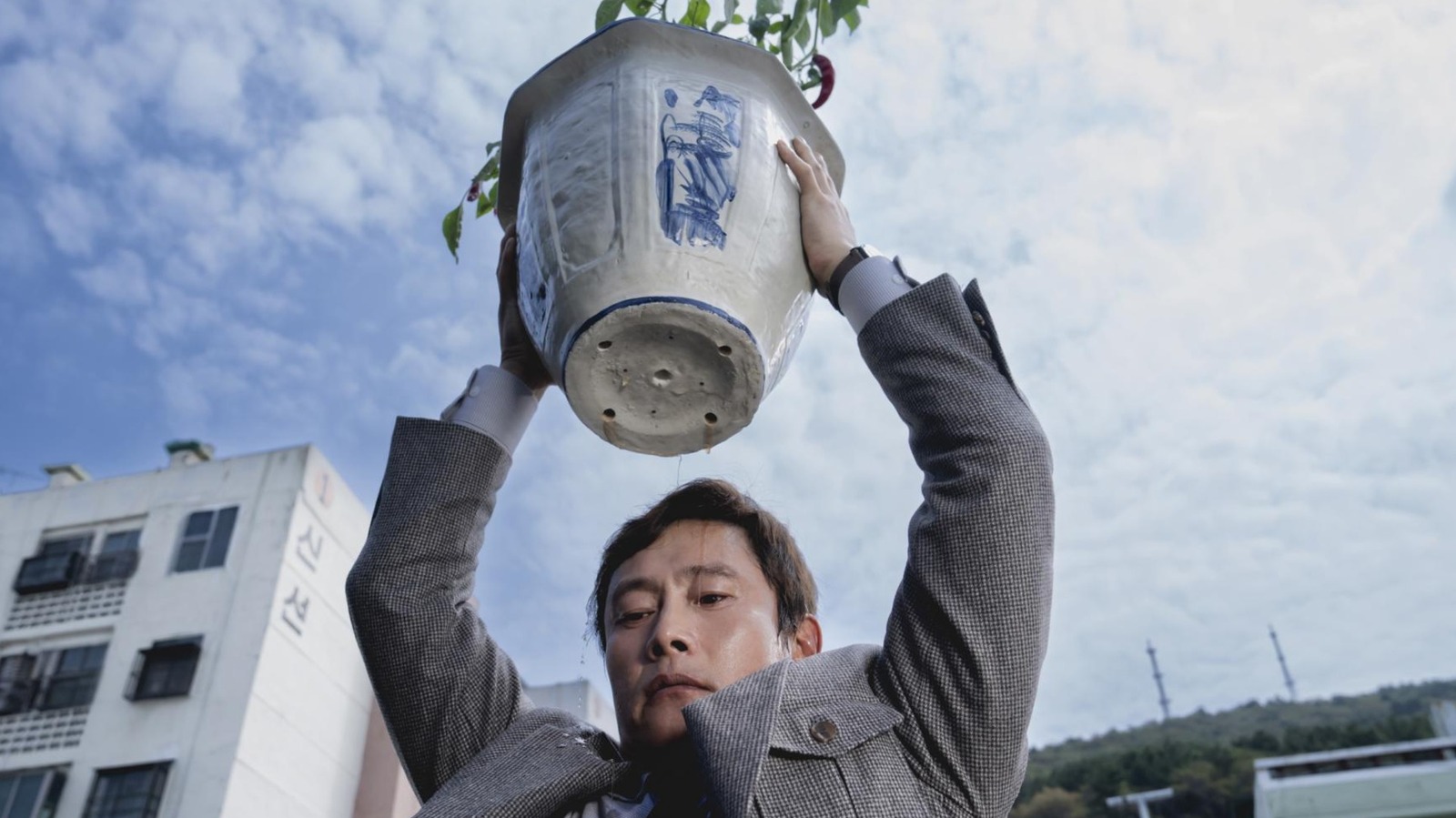

This article contains spoilers for “No other choice”.
Park Chan-wook opens “No Other Choice” with an idyllic snapshot of the nuclear family unit. Man-su (Lee Byung-hun), a wealthy salaryman, lives with his wife and two children in a beautiful country house, replete with a lush greenhouse and a magnificent front yard. “I have everything,” Man-su muses, truly grateful to have everything most can only dream of. But this comfortable lifestyle is brutally ripped away from Man-su after he falls victim to corporate downsizing, where none of his accomplishments (and decades of hard work) matter in the face of capitalism’s endless rat race. Given Park Chan-wook’s ability to create intense and gripping drama (look no further than his “Oldboy” or “Decision to Leave”), it’s natural to expect a similar tone in “No Other Choice.” This South Korean thriller is full of tragic pathos, but it’s also morbidly funny and profoundly absurd at every moment.
It’s tempting to think of Man-su as an ordinary man, but his socioeconomic status (upper-middle class) becomes the crux of his increasingly extreme motivations. Of course, he is a man wronged by a failed system, wantonly rejected for no justified reason. But Man-su’s anxieties have little to do with his inability to put food on the table: his main concern is that his unemployment exposes him to social indignity. This is why the story demands such a drastic escalation: whenever Man-su clumsily considers eliminating other promising candidates so he can get a new job, Park Chan-wook translates this desperation through stunning match cuts, transitions, and zooms. Each reflective surface becomes a mirror into one’s soul, and this deft visual mastery is matched by the farcical extremes of Man-su’s violently chaotic journey.
But how does “No Other Choice” achieve such carefully choreographed chaos?
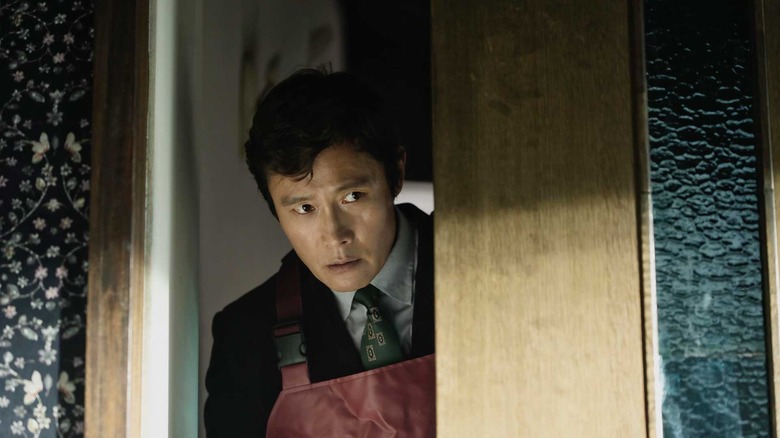
A job is never just a job in a hypercapitalist society. It is a source of income that consumes a significant part of our time, which is why it is linked to our sense of dignity and personal accomplishment. Such an economic system views unemployment as a personal failure, but it also creates an employment crisis by controlling the means of production. We see this happen when Man-su fails to find another job for months (despite his qualifications) and papermaking suddenly becomes a highly automated niche industry.
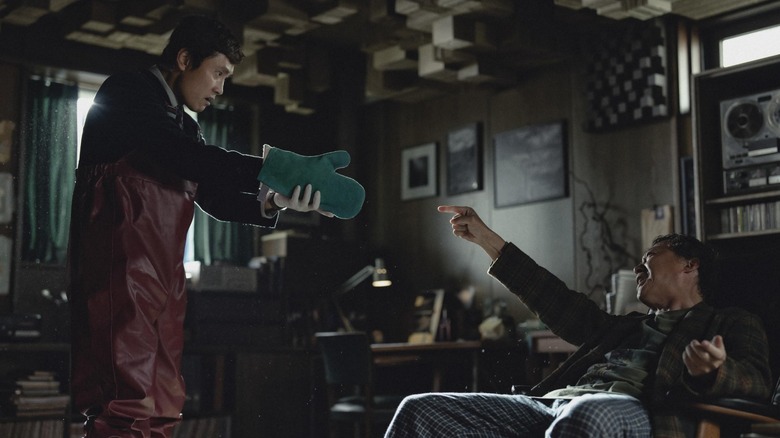
Instead of questioning this troubling status quo, Man-su finds grotesque ways to game it, having built his identity on a system designed to turn against workers like him (regardless of their economic aspirations). His justification is that he has “no other choice”: in his mind, murdering other workers he perceives as threats is surely the only way to regain his dignity. Park Chan-wook uses this ethical absurdity to introduce us to an anti-hero who turns every crime into Looney Tunes-style shenanigans, where Man-su clumsily stalks his victims and improvises his serial killings. A particularly brilliant (and brutal) sequence involving a drunken tooth extraction takes this feeling to the extreme.
These instances of over-the-top physical comedy are hilarious, thanks to a tense script and Lee Byung-hun’s complex performance. We’re never supposed to support him, but there’s, uh, no choice but to sympathize with someone so terribly disturbed by his inability to return to a lifestyle he’s accustomed to. The results are lopsided, as Man-su must abandon his humanity (and decency) to find a job. This pointed satire feels substantial because of the film’s impressive visual language, which stuns us just as much as Man-su’s increasing moral bankruptcy.
In “Decision to Leave”, Park Chan-wook uses quick cuts/transitions to move from one point of view to another.which serve to flesh out the central relationship of the film. Texting overlays are also used to great effect, juxtaposed with the micro-expressions of people involved in a digital conversation. Likewise, “No Other Choice” uses tablets, phone screens and bathroom mirrors to gauge character motivation, which reaches diabolical extremes with each passing minute.
For example, we see Man-su’s moral point of no return when a box containing his father’s gun is juxtaposed with his desperate, anxiety-riddled attitude. Additionally, a murder investigation takes place at one point, during which the reflective surface of a laptop is used to shift perspective and convey each character’s unspoken thought process. Such visual mastery may seem like unfettered improvisation, but it is the result of painstaking craftsmanship and precision.
This visual language fuels the film’s dense (if unsubtle) symbolism. Towards the end, Man-su inadvertently feeds his beloved apple tree with corpses, meaning that his now-flourishing career and restored social status come at a horrible cost. This is where the tragicomic nature of Man-su’s arc seems particularly bitter, as the film dangles the idea that advanced capitalism makes it easy for us to turn a blind eye to the atrocities that shape our reality. Man-su knows his actions are wrong, but it’s easy to put aside guilt or remorse when grilled eel returns to the menu. This is also why his wife, Lee Mi-ri (Son Ye-jin), remains silently complicit, because she realizes that the only way to win a rigged game is to accept moral compromise as inevitable.
“No Other Choice” is currently in limited release.