Physical Address
304 North Cardinal St.
Dorchester Center, MA 02124
Physical Address
304 North Cardinal St.
Dorchester Center, MA 02124


Too often people see the expression “based on a true story” and focus way too much on the “true story” part while skipping the “based on” part. It’s a problem that has existed practically since the beginning of cinema (if not before), and has given rise to everything from “print the legend” hagiography to people put themselves in mortal danger. However, it is not the public who bears all the responsibility. Certainly, hundreds of unscrupulous hucksters, hype men and advertising agencies have been all too eager to sell tickets using the lure of so-called reality when it comes to movies and television. In some cases, this went so far as to make the ads seem less like salesmanship and more like a kind of confidence game.
Several films released this holiday season are based on true stories: “The Testament of Ann Lee,” “Song Sung Blue” and “Avatar: Fire and Ash” (Okay, yeah, I’m kidding about that last one). “Marty Supreme” by Josh Safdie contains no warning about its roots in reality, neither in its advertising nor in its credits, and of course, many of the film’s scandalous elements and settings are the work of fiction. Yet while the film cannot be considered based on a true story per se, it is indeed based on a real person. In the film, Timothée Chalamet plays Marty Mauser, a New York hustler who uses every trick at his disposal to try to become world table tennis champion. Mauser is based on Martin “Marty” Reisman, a New York table tennis player and sometime champion. As such, “Marty Supreme” is not based on a true story per se, but is based in reality.

“Marty Supreme” is set in 1952, and the reason is not arbitrary. On the one hand, it was in the 1950s that the sport of table tennis (aka ping pong) saw its popularity expand beyond its English origins to include Asian countries. As Safdie’s film shows, this popularity led these countries to participate more often in official championships. Japan’s 1952 men’s singles gold medalist, Hiroji Satoh, is likely the inspiration for the character Endo in the film, played by Koto Kawaguchi, who becomes Marty’s professional rival. Additionally, in the 1950s, foam was introduced into classic table tennis rackets, which further transformed the game. This development is also mentioned in the film, albeit in a twisted way.
Of course, the main reason for the film’s period setting is that it’s loosely based on the life of Marty Reisman. Although the majority of incidents in the film are fictional, Reisman’s spirit can be seen throughout Mauser. Like his film counterpart, Reisman was born into an Ashkenazi Jewish family and was obsessed with table tennis from a young age. He sought money at various table tennis clubs and eventually competed in numerous championships, winning a total of 22 titles between 1946 and 2002. During his life, he became such a visible and flamboyant figure that he not only did comedy routines for the likes of the Harlem Globetrotters (as seen in the film) and appeared on talk shows, but he also became known for his signature style, as he often wore light-colored clothing and a sort of fedora. So while neither Mauser’s costumes nor the film’s viral jackets and other merchandise resemble Reisman’s style, they perpetuate his talent for flashy fashion.
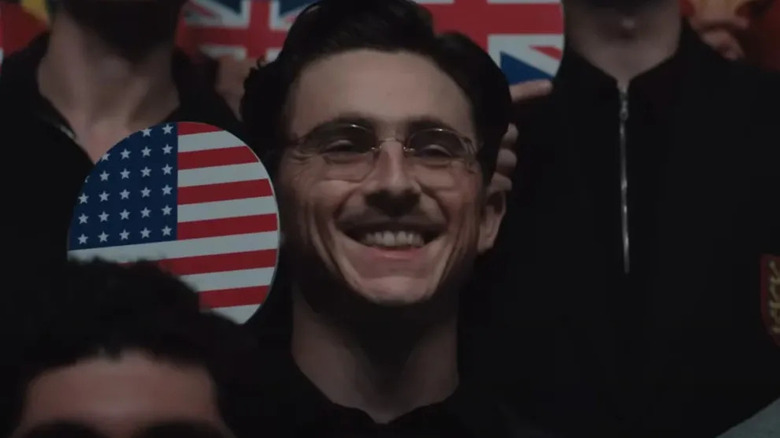
Although “Marty Supreme” and Chalamet’s performance undoubtedly pay tribute to Reisman, it would be misleading to characterize the film as a 1:1 scale adaptation of the latter’s life. Unlike the many other films that are loosely based on real people or events, Safdie and co-writer/co-editor Ronald Bronstein take “Marty Supreme” several steps beyond period verisimilitude. Certainly, the production design (courtesy of Hollywood legend Jack Fisk) and costume design (by Miyako Bellizzi) seem to be faithful to the 50s, like all diegetic music. Yet Daniel Lopatin’s original music is an electronic fantasy, creating a sound as close to 2025 as it is reminiscent of the ’70s and ’80s scores of German electronic music group Tangerine Dream. Safdie and music supervisor Gabe Hilfer double down on Lopatin’s sound direction, filling the film with a slew of ’80s pop/rock needle drops.
All this is to say that Safdie and “Marty Supreme” deliberately create a fictionalized world composed of a mixture of various elements, combining the historical and the ahistorical. This makes the film an intoxicating experience, one that intentionally dissociates the viewer from any sense of distance created by the period setting or the trappings of the story in general. In this way, Safdie can place the audience directly in the same emotional space as Marty Mauser, allowing the various chaotic events to feel even more powerful and immediate. As a result, the film is all the more emotionally true. While “Marty Supreme” may not be based on a true story, it is indeed based on a real person, and many aspects of Marty Reisman – his hustler nature, his love of table tennis, his weaknesses and small triumphs – are represented in the film.
“Marty Supreme” is in theaters around the world.