Physical Address
304 North Cardinal St.
Dorchester Center, MA 02124
Physical Address
304 North Cardinal St.
Dorchester Center, MA 02124
Although Netflix has been showing a recent propensity for creating the kind of mindless entertainment that’s specifically designed to be watched while doing other things, they also have a surprisingly impressive catalog of serious, well-made films and television series. A number of these are period dramas, either produced by Netflix or licensed for streaming, and each provides a sumptuous sense of escapism from present-day problems.
Whether they’re feature-length films, miniseries, or made up of multiple seasons, each offers up gorgeous costume design, luxurious sets, and historical storytelling that both entertains and educates (even if they have their fare share of historical inaccuracies). So if you’d like to take a journey into the past, here are some of the best period films and television series that Netflix currently has to offer in their streaming catalog. Just make sure you bring your own antibiotics, because, well, those are kind of a new thing.
Based on the novel of the same name by Daisy Goodwin, “Victoria” tells the story of the earliest days of Queen Victoria’s reign. It begins with the death of her uncle, after which the 18-year-old Victoria (Jenna Coleman, largely known then for her work on “Doctor Who”) ascends to the throne. But the start of a very long stint as English monarch is not without a few bumps. “Victoria” ran for three seasons, exploring Victoria’s somewhat co-dependent relationship with Lord Melbourne (Rufus Sewell), her marriage to the Coburg prince Albert (Tom Hughes), and the rapidly evolving England she finds herself in stewardship of.
Coleman is an excellent young Victoria, pixie-like but also stubborn and hot-tempered. Her complicated yet loving relationship with Albert (one that would come to a premature end with Albert’s sudden death at age 42, sending Victoria into a famously extended period of mourning from which she never recovered) is the highlight of the series, showcasing the give and take between a female monarch and her consort.
The 1994 adaptation of Louisa May Alcott’s classic novel “Little Women” is basically Christmas on celluloid. In it, the March sisters grow up in their quiet New England town, grappling with their father’s prolonged absence as a minister in the Union army and their resulting lack of significant income. But although they face various hardships, the special bond between the four sisters and their loving saint of a mother Marmee (Susan Sarandon) keeps their spirits up.
There have been many adaptations of “Little Women” over the years, but this is one of the most faithful. The performances throughout, especially Winona Ryder as Jo, Kirsten Dunst as little Amy, and Christian Bale as their wealthy next-door neighbor Laurie, are utterly charming. Although the March sisters are very different from one another, there’s a warmth to their interactions that makes watching this iteration of “Little Women” feel like a cozy winter hug.
If you’re a champagne aficionado, you may be familiar with Veuve Clicquot — it’s one of the most popular and acclaimed champagne houses in all of France. But not everyone knows the story behind the centuries-old company, or the woman who was at the heart of its emergence on the scene. In “Widow Clicquot,” as the name suggests, the young Barbe-Nicole Clicquot finds herself widowed at 27 and in charge of her late husband’s interest in the family vineyards.
Of course, since it’s the early 1800s, and she’s a woman, she faces constant threats to her finances and questions over her ability to run a business. But in spite of everything, she figures out a way to make the Veuve Clicquot not just survive in the midst of the Napoleonic Wars but thrive and evolve into the brand name we all know today. Both an inspiring true story and a melancholy tale of life after loss, “Widow Clicquot” is an underrated stunner.
For years, Grace (Sarah Gadon) has been imprisoned for a grisly murder — one that she claims to have no memory of committing. But is she the victim of trauma buried deep in her subconscious, or is she a cunning murderess? That’s the central question of “Alias Grace,” as a young psychiatrist (Edward Holcroft) begins the process of interviewing her to try to get to the bottom of why she doesn’t remember her crimes. But the more he gets to know her, and the more her dark and abusive family life is revealed, the more fascinated he becomes by her.
“Alias Grace” speaks to the lack of power held by women at the time and the avenues (including supernatural ones) by which they find an outlet for their pain and rage. Sarah Gadon’s enigmatic performance adds layers upon layers to the character of Grace, creating an intelligent and at times intense exploration of an untold history.
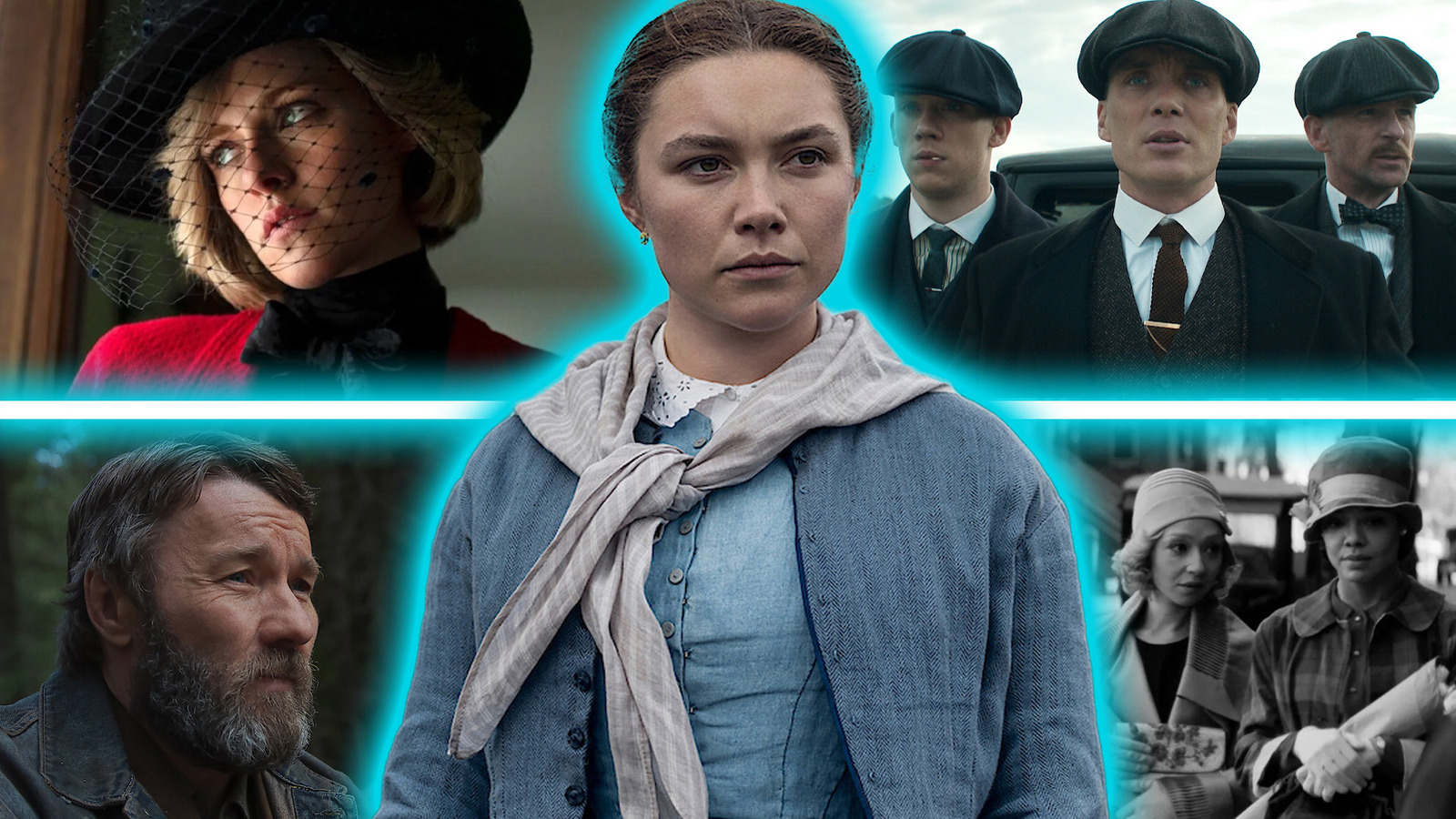
As far as we’re concerned, this is one of the best ways to approach making a film about a real-life person: Rather than attempting to cram every important moment of their life into a single two-hour movie, “Spencer” focuses instead on one particular Christmas in the life of Diana, Princess of Wales (Kristen Stewart). The relationship between Diana and Charles (Jack Farthing) has been on the rocks for a while, and its beginning to attract media attention, making their traditional Christmas at the Sandringham estate even more tense than usual.
This combines with Diana’s growing sense of paranoia and her recurring struggles with bulimia to create a strangely surreal environment, one that provides a welcome contrast to the traditional royal period drama. Stewart creates a vision of Diana as bird-like, trapped in a gilded cage. Director Pablo Larraín focuses almost exclusively on the inner life of Diana, making “Spencer” a perfectly-suited biopic for the People’s Princess.
Set in Ireland amidst the devastation that followed the Great Famine, the richly chilling “The Wonder” forces its characters to reckon with fact and fiction, superstition and science. Florence Pugh plays Lib Wright, a no-nonsense English nurse who is brought over to Ireland on an unusual mission. In a small Irish village, there is a little girl who appears to have forsaken food for months, yet still remains alive. She allegedly feasts on “manna from heaven” and is regarded by many as a miracle.
But a council of elders wish to investigate this child to see if her claims are true, and to that end, they bring in two professionals — a nurse and a nun — to take shifts watching her and report back on their findings. But as Lib works to uncover the truth, she is confronted with a battle between the deeply religious nature of the community — and their desire, after having lived through the horrors of starvation, to believe in a miracle that would allow a little child to overcome it — and her own logical, research-oriented inclinations. Florence Pugh is always a delight, but she’s especially well-used here set against a backdrop of vivid superstition in the face of immense pain.
There’s something about the British royal family that has entralled audiences for generations, and that spark continued with the Netflix original series “The Crown.” Beginning with Princess Elizabeth (Claire Foy) on the eve of her wedding to Prince Philip (Matthew Smith) and ending with the twilight of her reign as queen, “The Crown” is a sprawling dramatic epic that features a revolving cast of actors who bring to life the queen and the rest of the royal family. Although Queen Elizabeth II is at the heart of the show, it also makes room for the entire extended royal family.
Especially as the years go on, “The Crown” gives us a front row seat to the drama between Charles and Diana, amongst other dysfunctional family moments. Keeping things fresh is the show’s choice to recast every two seasons, allowing the characters to age beyond what stage makeup can accomplish. Although everyone has particular iterations of the cast that speak to them — as well as specific periods of history that they find most interesting — we’ve found that there’s something to like about each season of “The Crown.”
James Garfield isn’t exactly the most well-known American president, but he certainly makes an impression in “Death By Lightning.” Set in the years after the Civil War, this historical series follows the presidential campaign and eventual election of Garfield (Michael Shannon), as well as the rise of the man who would eventually kill him (Matthew Macfadyen). In its depiction of two mostly forgotten historical figures, it showcases all of the qualities that make the two characters so fascinating.
Garfield, reluctant to seek fame and glory but eager to make an impression on the landscape of the United States, is shot and dies from infection before having a chance to make much of an impact as president. And Charles Guiteau (Macfadyen), whose only goal seems to be to have his name live on, is relegated to obscurity. Written with verve and wit and bolstered by crackling supporting turns from Shea Whigham, Nick Offerman, and Betty Gilpin, “Death By Lightning” is one of the best Netflix shows of 2025.
Set in northern England in the aftermath of World War I, “Peaky Blinders” is a deep dive into a seedy underworld that never fails to entertain. This is due in large part to Cillian Murphy’s presence in the lead role as Tommy Shelby, the intelligent but often cold leader of the Shelby clan and their criminal enterprise who has been irrevocably changed by his time at war.
Over the course of the show’s six seasons, we watch him — and many other members of his family — evolve as anti-heroes, going from characters we can often root for to skirting the line of becoming irredeemable. “Peaky Blinders” has been one of Netflix’s premier historical dramas for years now, proving to the streaming service back in 2013 that there was definitely an audience for shows like this on their platform after their agreement with BBC that would allow them to distribute the series outside of the United Kingdom.
Few historical heroes come more swoonworthy than Ross Poldark (Aidan Turner) in “Poldark.” The son of a wealthy Cornish mining family, Poldark spend several years fighting in the American Revolution for the British forces and returns home only to discover that the woman he loves is about to marry another man. This, needless to say, is quite the shock for Poldark. To add insult to injury, his father has died, leaving both the family estate and its accompanying mines in extreme disrepair.
Over the course of the show’s five seasons, we watch as Poldark attempts to rebuild his fortunes and carve out a life for himself, one that includes the presence of his new wife Demelza (Eleanor Tomlinson), who he hires as a maid but ends up impulsively marrying. And as you might have guessed from his romantic exploits, a lot of the drama comes from Poldark committing unforced errors and getting in his own way. Nevertheless, it’s a lush, frothy period drama that is tough to put down once you’ve started watching — and Cornwall has never looked better.
Some period dramas go for big and splashy, but “Train Dreams” is the complete opposite: a quiet, atmospheric story of the early 20th century American dream. It stars Joel Edgerton as Robert, a man of few words who spends most of his time as a logger, traveling far away from him for months at a time to provide for his family. Over the course of his adult life, he experiences both tragedy and joy — as we all do.
Told with a keenly poetic verbosity and a stunning cinematographic style, “Train Dreams” is heartbreaking in both its beauty and its pain. Although Edgerton is the star of the piece, several other actors come into the story in fits and starts, adding a tremendous depth despite their limited screentime. William H. Macy in particular delivers a stunner of a performance in just a few minutes on screen. Moody and contemplative, “Train Dreams” is a thinking man’s period drama.
Given the treatment of Black Americans during the early part of the 20th century, it makes sense that some light-skinned people would try to pass as white, thus limiting their experiences of racial prejudice. But as we see in “Passing,” that decision did not come without its own dangers. In this 1920s drama, Tessa Thompson stars as Irene, the well-heeled wife of a prominent Harlem doctor, who reconnects with a long-lost former schoolmate, Clare (Ruth Negga), and is shocked to discover that she’s been pretending to be white. Which is an especially dangerous position to be in, given the extreme racial prejudices of her husband (Alexander Skarsgard).
“Passing” is defined by its sense of longing, shown through both its starring women. Although Clare has made a choice to embrace a world of whiteness, she sees Irene’s Black community in Harlem and wishes for that connection to her past. Irene, despite her best intentions, can’t seem to stay away from Clare. Put together, this creates a situation that can only end in tragedy.
Oscar-winner Mark Rylance has made a career out of playing soft-spoken characters whose intelligence and various other positive qualities are often overlooked, which makes him a perfect fit for the lead role in “The Outfit.” Set in a tailor’s shop in 1950s Chicago, it stars Rylance as Leonard Burling, an English cutter whose business is heavily intertwined with the Irish mob. Although they ordinarily maintain a more-or-less peaceful arrangement, things come to a head when two gang members, Richie (Dylan O’Brien) and Francis (Johnny Flynn) arrive, wounded and suspecting a rat in their midst.
Leonard is the picture of hospitality, despite the unfortunate circumstances — but there may be more than meets the eye when it comes to this humble tailor, and it quickly becomes clear that you underestimate him at your peril. An underseen mid-century throwback, the intelligent script of “The Outfit” makes it a blast to watch, even if it — like its lead character — initially comes across as passive and understated.
Ordinarily, the Western serves to prop up a particularly unsubtle form of masculinty, but “The Power of the Dog,” directed by Jane Campion, purposefully deconstructs it. Set in early 20th century Montana, the film revolves around a pair of brothers (played by Jesse Plemons and Benedict Cumberbatch), one who is kind, mature, and responsible, the other who is incredibly intelligent but cruel and uncouth, seemingly having killed every part of himself that could be considered vulnerable or effete.
But when the sweet but fragile Rose (Kirsten Dunst, playing opposite her real-life husband Plemons) and her strange, sensitive son (Kodi Smit-McPhee), come into their lives, tensions between the four (primarily instigated by Cumberbatch’s Phil) threaten to escalate. “The Power of the Dog,” with its thoughtful performances and stunning cinematography, was an awards darling, earning 12 nominations at the Oscars and winning one for Jane Campion as Best Director.
Set in the aftermath of World War II, “Mudbound” is a heartbreaking look at the reality of the Jim Crow-era South. It follows the trajectory of two men who, on the surface, couldn’t be more different. Jamie (Garrett Hedlund) is a white man from an established family in Mississippi whose father is deeply entrenched in the Ku Klux Klan, while Ronsel (Jason Mitchell) is the Black son of sharecroppers.
But when both men return from service in Europe, neither are comfortable with the established social order in their hometown. Jamie has made friends with Black pilots while serving, and Ronsel is no longer willing to bow and scrape to white people after fighting for his country. And so an unexpected friendship develops between the two — albeit one that will have devastating consequences. “Mudbound” is packed full of moving performances, and although it’s not an easy watch, it’s an essential one.



